
The Intentional Imperfection Strategy: A 5-Step Authenticity Audit to Transform Your Brand in 2026
Apply our 5-step 2026 Authenticity Audit to replace synthetic brand polish with intentional imperfection, visible process, and measurable customer trust.
 🔍 COVER PLATE — CLICK TO EXPAND
Can you engineer authenticity? It sounds like a contradiction, doesn't it? Yet here we are in 2026, with brands scrambling to look more human whilst simultaneously worrying that any deliberate attempt to appear imperfect will come across as utterly contrived. If you have been following this series, you understand the why behind the authenticity movement. Now it is time for the how.
Throughout the preceding six episodes, we have built a comprehensive foundation. We explored the trust crisis that makes synthetic perfection counterproductive. We decoded analogue textures as proof of human presence. We investigated tactile longing and screen fatigue. We traced photography's documentary turn toward unretouched reality. We unpacked post-luxury positioning and quiet quality. Most recently, we examined how physical spaces are becoming tech-light sanctuaries.
Today, we synthesise everything into actionable strategy. You will walk away with a systematic framework for auditing your brand's authenticity, clear guidance on pitfalls to avoid, sector-specific applications, measurement approaches, and capability-building advice. Because here is the counterintuitive truth: intentional imperfection requires more strategic thinking than synthetic perfection ever did.
 🔍 PLATE 01 — CLICK TO EXPAND
Plate 01 — Three Studio Colleagues Gathering Around Oak Worktable With Ceramic, Linen, and Packaging Samples: Plate 01 (Introduction): A multidisciplinary brand team translates tactile material research and documentary photography into an actionable transformation plan.
Why Strategic Imperfection Demands Greater Rigour
Let us address something crucial before diving into frameworks. Random imperfection reads as carelessness. Intentional imperfection reads as confidence. There is a world of difference between the two, and audiences can sense which is which almost instantly.
You cannot simply rough up your existing assets and expect trust to follow. Slapping a scratchy texture over polished photography or adding a vintage filter to stock imagery creates dissonance rather than connection. The imperfection must connect to genuine brand story, otherwise it becomes another form of artifice—perhaps even more cynical than the polish it replaced.
Think of it as a spectrum. On one end sits synthetic perfection: everything airbrushed, algorithmically optimised, and interchangeable with competitors. On the opposite end lies chaotic carelessness: messy without meaning, disorganised without purpose. The sweet spot—strategic imperfection—sits between these extremes. This is where visible humanity connects to authentic brand characteristics, where every texture, every unretouched detail, every revealed process tells a true story.
Systematic assessment must precede any visual changes. So let us walk through the five-step authenticity audit.
 🔍 PLATE 02 — CLICK TO EXPAND
Plate 02 — Craft Designer Measuring Handmade Uncoated Paper Box Edge With Steel Ruler at Oak Bench: Plate 02 (Strategic Imperfection Demands Rigour): Combining organic, irregular cotton fibres with exacting structural engineering proves that intentional imperfection is never carelessness.
The Five-Step Authenticity Audit Framework
Step 1: Audit Visual System Interchangeability
Begin by examining whether your brand's visual system could belong to any competitor in your category. If elements are interchangeable, they lack the specificity that signals genuine authorship.
Ask yourself these questions: Could this colour palette appear on three competitor websites without seeming out of place? Does the typography choice reflect any distinctive brand characteristic, or was it selected purely for professional appearance? Are imagery styles dictated by stock photography availability rather than brand story? Would removing the logo make the brand unrecognisable?
If you answered yes to most of these, you have identified where specificity injection is needed. This does not mean wholesale replacement—it means strategic differentiation rooted in genuine brand characteristics. Perhaps your founder has a background in ceramics, and earthy, tactile colour references would be authentic. Perhaps your team works in a converted Victorian warehouse, and architectural details could inform your visual language.
Step 2: Reveal Process Through Work-in-Progress Content
Determine whether your brand currently reveals any evidence of human process, or whether only finished outputs are visible to audiences.
Consider: Does your audience ever see work-in-progress imagery? Are the humans behind products and services visible and recognisable? Is there any content showing decision-making, iteration, or problem-solving? Does the brand share learning moments, or only polished successes?
Process revelation builds trust because it demonstrates competence rather than merely claiming it. Identify existing process moments that could be documented and shared—genuine stories rather than manufactured behind-the-scenes content. The fitting session where a garment was adjusted three times. The recipe that failed before it succeeded. The sketch that preceded the final design.
Step 3: Use Texture With Meaning and Brand-Specific Relevance
Assess whether any analogue textures currently in use connect meaningfully to brand story, or whether they function as purely decorative additions.
If paper textures appear in your materials, does your brand actually use paper in its process? Do film grain effects connect to any genuine photographic heritage? Are hand-drawn elements created by actual humans within or connected to the brand? Does texture choice reflect materials you actually work with?
Remove textures that lack genuine connection. Instead, identify authentic materials and processes that could be visually referenced. A ceramicist should show clay textures. A publisher might reference manuscript papers. A food brand could incorporate the natural imperfection of handmade tableware. The texture must earn its place through meaning.
Step 4: Allow People to Remain Recognisable
Evaluate your current approach to human imagery. Does portraiture maintain recognisable humanity, or does retouching smooth away distinguishing characteristics?
Would your employees recognise themselves in brand imagery? Are skin textures, expression lines, and natural variations visible? Do models and staff look like individuals or interchangeable representatives? Is diversity of age, body type, and appearance genuinely represented?
Develop retouching guidelines that preserve humanity whilst maintaining brand standards. Define what correction serves clarity—removing a temporary blemish, adjusting lighting inconsistencies—versus what erases personality. The goal is recognisable humans, not mannequins.
Step 5: Maintain Transparency About AI and Automation
Finally, assess your brand's current relationship with AI-generated content and determine appropriate disclosure strategies.
What percentage of current content involves AI generation or significant AI assistance? Is there clear internal guidance on when AI use requires disclosure? Does your stated position on authenticity align with actual content creation practices? Are there opportunities to differentiate through transparent human authorship?
Develop clear AI disclosure policies. Identify content categories where human authorship provides competitive advantage worth emphasising. In 2026, with consumer research showing that 55% view brands less favourably once they discover AI created their content, transparency is not merely ethical—it is strategic.
 🔍 PLATE 03 — CLICK TO EXPAND
Plate 03 — Overhead View of Five Authenticity Audit Stations Across a Worn Wooden Studio Table: Plate 03 (The Five-Step Authenticity Audit Framework): Five structured review zones across a studio worktable evaluating touchpoint sameness, process visibility, material truth, imagery, and digital calm.
Common Mistakes That Undermine Authenticity
Applying Generic Handmade Filters Without Brand Connection
Brands often layer scratchy textures, distressed type, or vintage colour grading over existing assets without any strategic rationale. Audiences sense the disconnection between aesthetic treatment and actual brand reality. A tech startup with no heritage applying aged paper textures reads as costume, not character.
Confusing Chaos With Authenticity
Messiness does not equal humanity. Authentic brands are often meticulously organised; their imperfection appears in specific, meaningful places rather than as general disorder. Strategic friction differs fundamentally from careless execution. A beautifully organised workspace with visible tool marks differs entirely from a genuinely disorganised mess.
Overdoing Imperfection Until It Becomes Affectation
Some brands, having understood the value of human evidence, proceed to exaggerate imperfection until it becomes as performative and artificial as the polish it replaced. This is the effortful effortlessness trap. If every image has perfect imperfection in exactly the same way, audiences recognise the formula. Restraint matters.
 🔍 PLATE 04 — CLICK TO EXPAND
Plate 04 — Designer Setting Aside Artificially Distressed Print in Favour of Genuine Uncoated Paper Stock: Plate 04 (Common Mistakes): Rejecting costume authenticity and repetitive digital grunge overlays in favour of quiet, structurally honest materials.
Sector-Specific Applications
Fashion and Beauty
Move from airbrushed perfection to visible skin texture and genuine expression. Show garment construction, fitting sessions, and material sourcing. Feature models as individuals rather than interchangeable mannequins. The beauty lies in recognisable humanity.
Food and Hospitality
Reveal kitchen realities rather than only plated perfection. Show hands that prepare food and faces that serve it. Embrace the beautiful imperfection of handmade cuisine—the slightly uneven edge, the rustic presentation that signals genuine craft.
Craft and Wellness
Document making processes and practitioner expertise. Show tools, workspaces, and the physical evidence of skilled labour. Connect product imperfections to handmade value—the variation that proves human touch.
Publishing and Media
Reveal editorial processes, drafts, and creative decisions. Make writers, editors, and designers visible as individuals. Show the human judgement behind content curation that algorithms cannot replicate.
Premium Consumer Goods
Emphasise material provenance and manufacturing craft. Show quality control processes and the humans who ensure standards. Connect premium pricing to visible human expertise and care.
Across every sector, the common threads remain: process revelation, human visibility, and meaningful texture. The specific applications differ, but the underlying strategy stays consistent—connect visible imperfection to genuine brand characteristics.
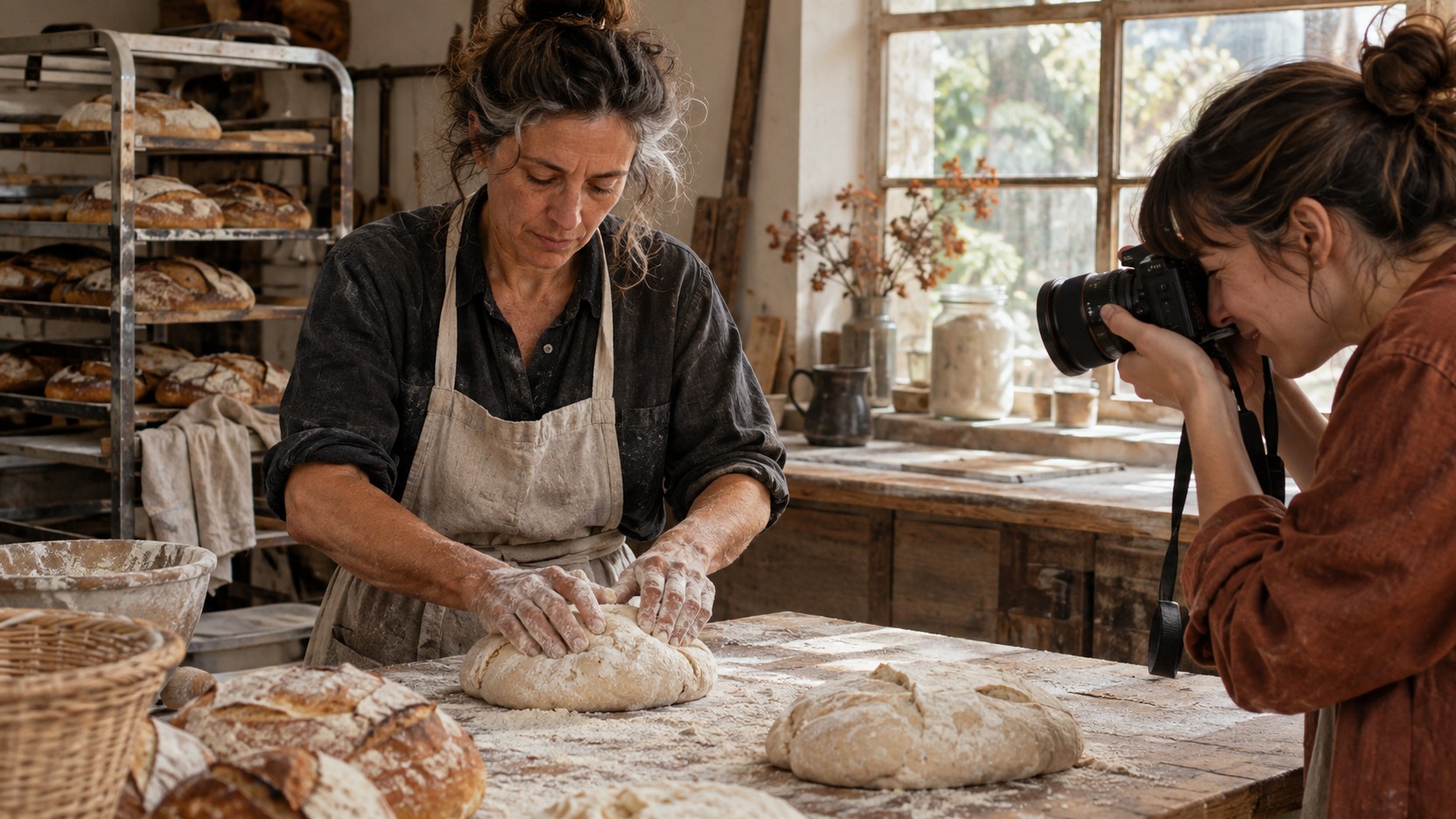 🔍 PLATE 05 — CLICK TO EXPAND
Plate 05 — Artisan Baker Shaping Sourdough Loaf With Flour-Dusted Hands While Colleague Documents Process: Plate 05 (Sector-Specific Applications): Demonstrating real production provenance in food, craft, and retail by documenting actual makers and batch variation.
Measuring Authenticity Impact
Authenticity's value appears in business metrics, not just design awards. Look for engagement depth: time spent, scroll depth, and return visits rather than mere impressions. Track trust indicators: direct traffic percentage, branded search volume, and referral quality. Monitor conversion quality: customer lifetime value, repeat purchase rates, and referral likelihood. Assess content performance: organic sharing, user-generated content volume, and community engagement.
A word of caution: authenticity investment often shows delayed returns. Trust builds gradually. Set appropriate measurement timeframes and avoid reverting to synthetic approaches based on short-term metrics. The compounding benefits of genuine connection take time to manifest.
 🔍 PLATE 06 — CLICK TO EXPAND
Plate 06 — Two Colleagues Reviewing Customer Photo Prints and Long-Term Retention Trends at Oak Desk: Plate 06 (Measuring Authenticity Impact): Evaluating qualitative customer sentiment, organic unboxing shares, and repeat retention alongside commercial performance.
Building Internal Capabilities
Sustainable authenticity requires capability development across several areas. Teams need a documentary mindset—training to capture genuine moments rather than only staging perfect ones. They need story recognition skills—instincts for identifying authentic stories already present within the organisation. Texture literacy helps teams understand which materials and processes genuinely connect to brand reality. Retouching restraint requires guidelines and skills for maintaining humanity in portraiture. AI transparency protocols establish clear policies for disclosure.
These capabilities require practice and cultural shift, not just tool acquisition. Consider phased implementation, starting with one area and expanding as confidence grows.
 🔍 PLATE 07 — CLICK TO EXPAND
Plate 07 — Experienced Photographer Coaching Junior Colleague on Observing a Ceramicist in Natural Light: Plate 07 (Building Internal Capabilities): Training internal brand teams in observational photography and material literacy reduces reliance on generic stock libraries.
Moving From Theory to Practice
Intentional imperfection represents strategic evolution, not creative regression. The five-step audit provides a systematic approach to building brands that feel genuinely human. If you have followed this series, you now possess both theoretical understanding and actionable tools.
Begin with the audit framework. Identify one area for immediate attention rather than attempting wholesale transformation. Perhaps start with portraiture guidelines, or with process documentation, or with an honest assessment of texture usage. Small, genuine changes compound into transformed brand perception.
In our final episode, we will explore how these approaches will evolve—which elements represent enduring shifts versus temporary aesthetic trends, and how brands can build flexibility into their authenticity strategies for whatever comes next.
 🔍 PLATE 08 — CLICK TO EXPAND
Plate 08 — Designer Photographing Colleague Assembling First Uncoated Product Packaging Prototype at Dusk: Plate 08 (Moving From Theory to Practice): Starting with one high-impact customer touchpoint creates immediate momentum toward an authentic brand system.
⚡ 5 Strategies to Consider
STUDIO PLAYBOOK // 5 DIRECTIVES❓ Frequently Asked Questions — 5 Q&As (5 Q&As)
SCHEMA.ORG/FAQPAGE // 5 Q&As (5 Q&As)Q1. How do we maintain brand consistency whilst introducing intentional imperfection?
Imperfection does not mean inconsistency. Define specifically where imperfection appears—process imagery, texture choices, portraiture approaches—whilst maintaining strict consistency in other areas such as core identity elements, messaging frameworks, and brand voice. The key is strategic placement of human evidence within an otherwise coherent system.
Q2. What is the budget implication of authentic content creation versus stock imagery and AI generation?
Authentic content often requires greater initial investment in documentation, photography, and capability building. However, efficiency gains emerge through internal capability development, and the long-term value lies in owning unique, unreplicable assets that competitors cannot easily duplicate. Consider it brand equity investment rather than content expense.
Q3. How quickly should we expect to see results from authenticity-focused changes?
Trust-building occurs gradually, typically over six to twelve months rather than weeks. Short-term engagement metrics may not immediately reflect authenticity investment. Set realistic measurement timeframes and track indicators like return visit rates, branded search volume, and customer lifetime value rather than expecting instant conversion improvements.
Q4. Can small brands with limited resources compete on authenticity?
Authenticity can be advantageous for smaller brands. Genuine stories are often more accessible when founders remain involved, human presence is easier to show in smaller teams, and lack of corporate polish can become a strength rather than limitation. Smaller organisations can often move faster and reveal more genuine process than large competitors.
Q5. What is the difference between intentional imperfection and careless execution?
Intentional imperfection connects to genuine brand characteristics and appears in specific, meaningful places that tell true stories. Careless execution is random messiness without strategic purpose. The former signals confidence and authenticity; the latter signals incompetence. Every visible imperfection should earn its place through meaning.
EXPLORE RELATED STUDIO TAGS (10):
Glad this piece sparked something — want the matching 4096×4096px .ZIP pack?
Enter your email below for an instant direct download of Studio Seamless Pattern Pack — Drop 01 (WPAY_DROP01.zip) plus new Studio Journal essays & free drops.